
A dementia story set in coronavirus times
He shook his hands vigorously at the sink, then turned round to face us. Youngish, but his purple scrubs signalled seniority, set him apart from colleagues busy in the corridor, the other side of the curtain.
— So tell me what happened.
— Well, Lena’s dementia is pretty far advanced and her legs don’t work too well in the morning. She sleeps downstairs now, so after I get her up, we start her day with a walk round the dining-room before I take her upstairs to the bathroom. This morning I was supporting Lena with one hand and had a cup of coffee in the other. She lost her balance, but with my coffee I didn’t have proper control. She fell and the back of her head went crashing into the radiator. I don’t think it’s too bad — she didn’t spurt blood — but there’s a nasty-looking gash — a centimetre or two wide. I called our surgery and they told me they’re not seeing patients but I ought to check it out here at the hospital.
— OK. Let me take a look. Can she sit up here, please.
He patted the bed in the middle of the tiny ward. I knew there was no way we could get Lena onto it, not at that height.
— I don’t think we can.
— Ah, yes — I see. OK, so we’ll keep her in the wheelchair then.
— Let me put the brakes on so she doesn’t roll away.
It was only the second time we’d ever used the wheelchair we’d been loaned, and I was still getting used to its dimensions. It was in the tight space between the bed and the wall. I needed to reach down to the wheels, to clamp them. But that would take me dangerously close to our medic. I hesitated.
— OK?
— Er … social distancing?
— Oh …
He half-smiled, shrugged and moved back to give me space. He’s not wearing a mask, I thought. But then, they didn’t deal with coronavirus cases in this department. There’d been a sign in the waiting-room explaining that Covid patients would be tested and treated in a separate unit. They’d asked in reception whether we had any symptoms and when I answered no, they trusted us. We weren’t wearing masks either. So we were all trusting each other.
He gently parted the hair at the back of her head and found the injury.
— OK. Here it is. Yes. Well, we’re going to need a stitch or two. Maximum two. So first I just need to cut a little of the hair away. Not much. You won’t even notice it.
— Do you need me to help? To keep her still?
— No, she’ll be fine.
Lena certainly seemed fine, showing no distress. Showing nothing really.
She’d tripped and fallen several times recently on our daily walks to the shops. I always hold her hand these days and until this morning, I’d always managed to prevent injury. It shakes her up of course, but in a few minutes, she always makes a full recovery, ready to go again. But is she really OK? She doesn’t have the language now to express sensation or feeling. I can only judge by instinct, by my intimate knowledge of Lena after all our years together.
This morning my judgement and my instinct had failed her badly. What was I thinking of, picking up the coffee? Why hadn’t I taken both her hands? I knew how fragile and unstable she’d become, my crazy strong dancer. It wasn’t just the street-falls. For the last couple of months the staircase had been perilous too. Going up, a five-minute haul, constantly checking that each hesitant foot was making the right height and distance calculation. Coming down, life-threatening — for both of us; I led the way so that if she fell at least she’d land on something soft.
I’d made a decision after today’s accident. Lena was grounded: no more stairs. But how was I going to cope, with the bathroom now off-limits? I cursed myself for not following up on the grant application with social services to install a downstairs bathroom. They’d said they’d visit to review within twelve weeks. Five months had passed. No way they’d come now. Not with the pandemic.
Was the time coming where Lena would need to go into care? I’d always promised myself that would never happen, I’d never pass her over to strangers. Oh they’d be well-meaning of course, loving perhaps, but it would be a betrayal of the woman who had been my wife and life-partner — and who was now my child. I’m not the kind of person who could give my own child away.
And yet might the professionals give her better care than I could? They’d have protected her better, wouldn’t have let her fall. They’d have proper toilet and showering facilities. Soon she’ll be struggling to eat — it already takes an age to feed her — and they’ll know exactly what to do. They might be more patient than me, and offer better entertainment.
As the medic continues his work, Lena’s started burbling away to herself, providing her own entertainment.
— Heya-hiya-hemma-ar-diddi-diddi-dum-dum-ala-la-la …
— Do you understand what she’s saying?
— She’s Swedish …
— Aha. So that’s Swedish?
— No, not the words. Some of the sounds. She’s lost all her language in the last couple of years — the dementia, you know. But we understand each other, Lena, don’t we?
I smile. She smiles back. But there’s a faint, knowing irony in her eyes. ‘What are we doing here, the two of us? How has it come to this?’ Is that her message, or am I just over-interpreting?
It occurs to me now that the medic’s English is slightly accented. So, like Lena, he’s learnt my language, and we understand each other perfectly. But not at the level Lena and I communicate, she without words.
He’s finished with the hair.
— OK, I may need your help now, just to hold her still while I stitch. She’s going to feel it a little.
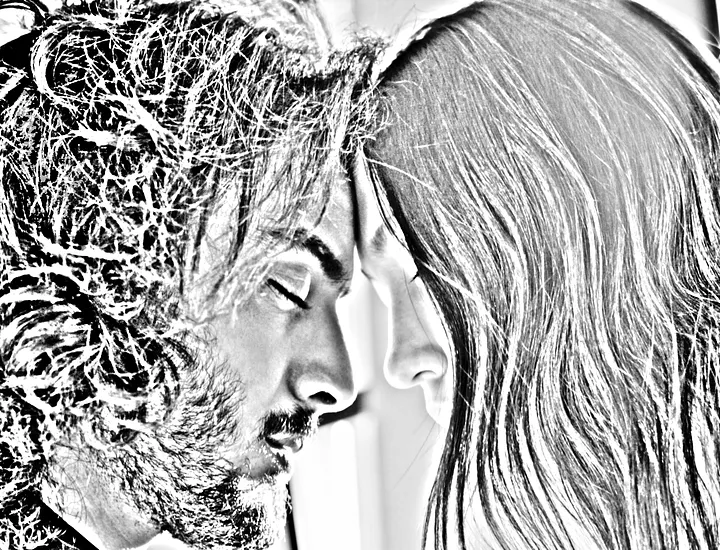
I bend down in front of her, take both her hands. And then, for comfort and support, gently press my forehead against hers. Her eyes lock on mine but they’re trusting, assured. She closes them. So do I.
Her brow is warm and familiar, perfectly still. In this state of physical relaxation, so rare recently, memories swirl into shape, sharpen, take colour. We’re young lovers again, embracing in a steaming ocean. We’re mourning the child we lost. We’re celebrating the birth of another. Our shared experience summoned and articulated …
… and then suddenly swept away by a surging torrent of raw feeling — joy-hope-fear-triumph-sorrow-adventure-concern-disaster-faith-pleasure …
Is she transmitting, or am I? Or both of us?
… and assurance and confidence and calmness and certainty …
The flow is slowing and steady now. I understand what we both need and want.
… and care …
The two of us together — we’ll manage somehow — just like we always have.
… and love …
— There. We’re finished. Two pretty blue stitches.
The professional has done his job perfectly. So now it’s up to me.
Our eyes open. We grin.
* * *
Written in 2020, this story is from ‘The Marathon Years’, a collection describing our long journey with dementia. The full book will be published in 2027, but you can already read many of the chapters here on the website.
If you know others who might find these free dementia stories helpful, don’t hesitate to share with them.
