
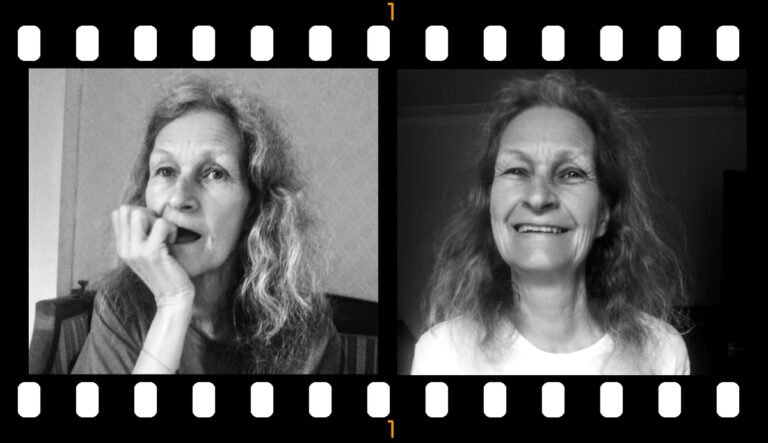
Lena, five years after her dementia diagnosis. Sometimes pensive, sometimes smiling (Photos: Alan Miles)
After Lena’s diagnosis, I was full of ideas about improving life for people with dementia and their family carers. But did I practise what I preached? A story from my forthcoming book ‘The Marathon Years’.
It’s 6pm and I’ve spent the whole day on the computer. I should stop now and throw something together for dinner. But I must get this newsletter finished. It’s important – explaining the differences between a normal daycare centre and The Bine. And I’m scheduled to publish today. Just a few more minutes…
“Many care homes and daycare facilities are wonderfully kind and comfortable. Nevertheless, most of us think of them as places where you’re gradually signing off from life … a golden sunset. We’d prefer our daily activity centre, The Bine, to be seen as a beautiful sunrise, the anticipation of a new day.”
Odd to be writing about sunset and sunrise on a day like today. It hasn’t stopped raining for the past 24 hours. It’s been grey and cold, one of those nothing days.
Nothing. That’s probably what Lena’s doing. She’s been quiet downstairs for a while. I haven’t seen her since I popped out to the corner shop a couple of hours ago. Perhaps she’s dozing. I’ll leave her for a few more minutes.
“Other Bine characteristics? Well, FUN will always be high on the agenda. PHYSICAL ACTIVITY too. We want to keep our members mobile and participating in our outside activities for as long as possible. Just being able to go for a walk is important.”
I didn’t take Lena to the shop today. Well, it was chucking it down, so she wouldn’t have liked it. And besides, it was just to get milk and bread. I was only going to be away for ten minutes. It would have taken longer than that to find her shoes and coat and get them on.
But I couldn’t just leave her alone any longer. Time to take a break.
* * *
— Hello.
— Hello.
— What you doing?
— Huh?
— What are you doing?
— Oh. Nothing.
Sitting there at the dining-table, with her head resting on her hand, her face was as long as her day had been.
I headed for the kitchen, looking for something I could just whizz into the oven now it was this late.
Oh, she’d been busy. The oven – the fan-oven I never use – was switched on. And where was the umbrella? I’d left it drying in the sink.
— Lena.
— Yes?
— Have you seen the umbrella?
— What?
No, forget it. Umbrella’s not a word she’ll remember.
— Are you coming to help me?
— Yes.
But she didn’t. So I went to turn the TV on, scanned through the channels till I found something with audience laughter. Sometimes that’s enough to get Lena’s attention, even if I’m not sitting there with her.
Waiting for the food, I was back in thinking mode. Why was this newsletter taking so long to write? Was it even a good use of my time? How could I get my Bine message across faster, reach more people?
I smiled ruefully as I remembered a conversation I’d had with a friend last week. There was so much he needed to change in his small business, he said, but he never had time. Stop and take stock, I’d advised, or it’ll just get worse and worse.
It’s easier handing out good advice than taking it yourself. I knew I needed to stop and think too. But after I’d finished the newsletter. Maybe.
The food was ready. I’d paid so little attention that I can’t remember what it was now. Something Chinese though, with rice, and easy to eat with a spoon, so I risked serving it in front of the TV. Lena often struggles with food on her lap these days. Anything runny invariably ends up all over her or on the floor. But this, whatever it was, seemed safe. She managed to cope well, and cleared the plate.
Now perhaps, I could get her to settle down with me for a while, watching the TV on the sofa. After all those hours writing, I really owed her some of my time and attention.
But no, after a few minutes she was up and pacing, finally coming to a halt just in my peripheral vision as I watched the screen. Without looking, I knew she was staring at me. And I knew why.
— Are you tired?
She nodded.
— Shall we get ready for bed?
— Yes, om du vill.
The Swedish for “If you want”.
So we went upstairs. There in the bed was the umbrella. A new variation on wetting the bed.
* * *
Fifteen minutes later, I was back at work on my Bine description.
“Some may decide they don’t want to participate right now. If that’s their choice, that’s their right. Perhaps they just want to rest for a while. Telling your brain to keep up all the time can be tiring with dementia.”
But the reason Lena was in bed wasn’t because her brain had been working overtime. She was tired because she’d had no stimulation all day long. She was bored.
That’s why we desperately need a place like The Bine, an everyday, all-day community space for people like Lena. With dementia, it’s not enough simply to take care of the basic functional needs – keeping people safe, warm, fed, clean, medicated. That might be enough for a pet. But we’re dealing with people. And people need to belong, to share, to have purpose and variety and choice, to feel free. None of that changes with dementia. The only difference is that now, just the same as with the functional needs, people need a bit more outside help. Or in Lena’s case, with Alzheimer’s well advanced, a lot more help.
Technically, the brain is not a muscle. But just like a muscle, it needs exercise. Stop using it altogether and it withers and dies.
There’s an uncomfortable paradox in my life. Here I am, campaigning for The Bine, purporting to know all the answers, talking about getting people reconnected and engaged. But every moment I spend at the computer, I’m leaving Lena alone and unengaged. I’m a fraud.
How much time have I actually spent with her today? Maybe a couple of hours. How have I stimulated her? Hardly at all. All I’ve done is the functional stuff. And I wonder. Am I capable of giving Lena what she needs? Would she be better off in full-time care? Not because she wants it, but because I’m failing her. At least there’d be other people around.
* * *
It’s 2am, and my newsletter is finally finished. I close everything down, then go into the bedroom, deliberately making just enough noise to wake Lena. It’s become a habit recently, after we had a series of bedtime accidents. I write till the early morning hours, then before turning in myself, I rouse Lena, and lead her to the bathroom. So far, it’s working well.
The bedside light is on – I always leave it on – and I can see she’s awake, though her eyes are still closed. I gently call her name:
— Lena. It’s that time. Shall we go to your nice bathroom?
A smile plays on her lips. She knows it’s me, and she’s happy I’m there. She stretches, but the bed is warm and comfortable. She’d like to stay there. But when I take her hand, there’s only token resistance. She knows what she has to do, and slowly allows herself to be eased out and up. As her feet touch the floor, she sings her little going-to-the-bathroom-in-the-middle-of-the-night song:
— Dum ti dum ti diddly doo.
I take her other hand and we slowly work our way along the corridor, me the train, she the carriage, puffing and hooting as we reach the bathroom door. I shunt her in, help her with the clothes, sit her down.
She’s still only half-awake, but she’s studying my face as I stand by the door, waiting. There’s trust in her eyes. Then she suddenly breaks into a broad grin. So do I. She snorts, and she’s giggling, can’t stop. Isn’t it silly, this situation we somehow find ourselves in? I’m giggling too.
How could I ever have thought that Lena might be better in someone else’s care? How could anyone else know the secret codes, the little looks and touches and gestures and words and timings built up between us over years? Without them, a dementia life would be intolerable. With them, there are still little moments of delight.
I’m on the right track with The Bine, I’m sure. A care solution that would preserve and protect our home relationship, while giving Lena the social stimulation that I’m struggling to provide.
I’m struggling, but I’ll try to do better tomorrow.

2 responses
What and where is The Bine?
Is Lena still with you?
My wife is in mid to early late stage ALZ.
Thanks for sharing your journey.
-Jerry From Ventura County, CA, USA
Hi Jerry — Thanks for getting in touch. I was meaning to write to you today after your comment on Medium the other day. Thanks for reminding me.
To answer your questions, no, sadly, Lena isn’t still with me. She was officially diagnosed in 2013, a couple of years after I was certain that something was seriously wrong but doctors disagreed with me. She then made it through till February 2025, and I was able to keep her at home with me throughout. But it was a struggle, not because Lena was ever a difficult patient, but because there was so much I didn’t know, and even with supportive grown-up kids nearby, I felt so much alone. I imagine, from your message on Medium, that you might feel the same. I really hope for you that the move to assisted care will give you and your wife the support you both need.
As for The Bine, I first began putting the idea together in around 2016. It seemed to me that the key to wellbeing for someone with dementia was keeping their carers fit and healthy, avoiding burn-out. To do that I wanted to find a way to release carers from 24/7 care, to give them back some of their own lives. Not just a couple of hours here and there, but whole days off. Also I knew I wanted to share knowledge and experiences with others, to learn from them. So that was the first idea: The Bine would be a place where people came together every day instead of being isolated in their homes. But how would this be different from the dreary daycare places I’d seen, where people seemed to be parked, just politely waiting for the end? I felt that everybody, including people with dementia, could and should still feel that they were involved, had a role to play. were contributing in some way. For Lena that was still possible for a long time after diagnosis — even though she lost all communication skills at a relatively early stage.
I started writing about The Care Combine, joining one of Seth Godin’s writing projects, and people all over the world started getting in touch, to say the ideas could work in their countries too. And here in Manchester, (the UK Manchester), I was all set for a pilot project, working with the local city council. But then two things happened. First the pandemic. And second, Lena’s health declined dramatically _ by the end of 2020, she was bedbound. With increased care responsibilities, there was no way I could take the project forward. I didn’t have the time — or frankly, the inclination, to write for those final years.
Since I lost Lena, I’ve been gradually bringing The Care Combine back to life. First I wanted to write the story of our dementia experience. ‘The Marathon Years’, here on the website, is a series of short stories where each story fits into a stage of a marathon. (I took up running again at age 64 as an escape from dementia duties.) So there’s the Start-Line, Going Well, The Turn (when things start to get harder), The Wall (when you think you’re never going to make it to the end), The Finish Line, and Recovery. Most of the stories I’ve published here so far deal with the earlier stages of our time after dementia came to live with us, but there’ll be about 80 eventually, right through till today — writing is part of my Recovery process. My hope is that carers may draw comfort and possibly guidance from them, although nobody’s experience will ever be exactly the same.
And then separately, I’m writing about The Care Combine, a blueprint for a new approach to dementia care. Between now and year-end I’ll be publishing a new article weekly. (You might have noticed a new one today —’Do Schools Need Fixing?‘ — both here on the website and on Medium.) My purpose in the coming months is to excite interest and assemble a team of people who can help to turn ideas into action.
I realise that this isn’t a great deal of help to you now — you’ll wish, as I did, that The Bine was here already. The long-term plan is that a core Care Combine team will develop a strategy, materials, standards, funding and sponsorship relationships that will allow any community anywhere to set up Bine Centres. This would give people with dementia, their carers, and their extended families the support they need during the early to mid stages of the illness. One of the principles I’d like to see enshrined is that nobody should be denied that support because of their inability to pay.
Please do stay in touch, Jerry, It’s people with lived experience like you who can help to shape this project, adding ideas, telling us where we’re getting it wrong, contributing your own stories and experiences, perhaps at some stage joining the team.
I wish you and your wife well. (And I promise not to write so much next time!)