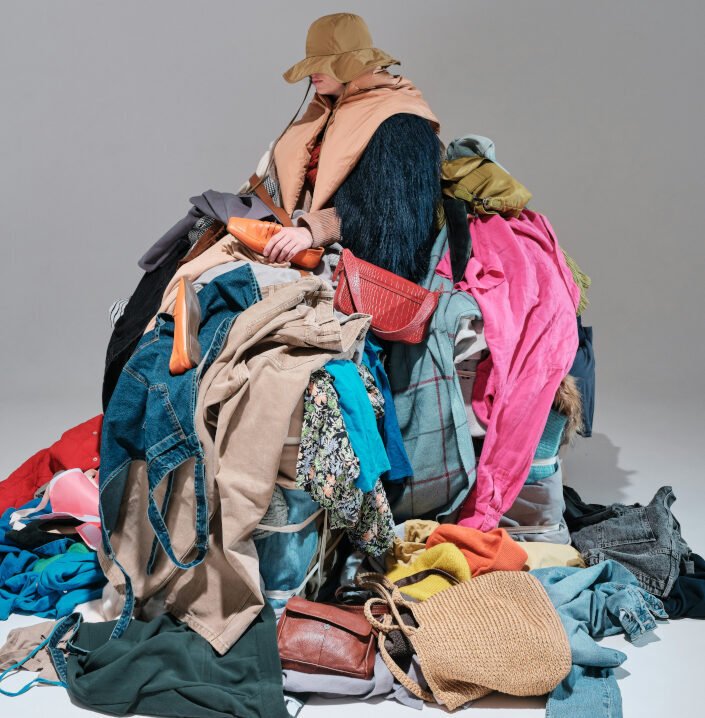
When clothes stop making sense, even life’s little pleasures get complicated.
Lena’s grumbling to herself in the bedroom.
— What’s wrong with these things? … Why? … Grr!
She knows I’m just down the hallway, on the computer. She’s telling me she needs help. Better go.
— You OK?
— No, look at these things. I don’t know what’s wrong with them. Look.
She’s sitting on the edge of the bed. It’s a jeans problem.
— Well, I think you’ve got them on inside out. Look, this seam here goes on the inside.
— No! This is the way they always are. I know how to put on trousers.
— Let’s give it a try anyway, shall we? Here, let me pull this leg.
It’s the third time this morning she’s changed clothes. She’s bored. Time for a change of scene, a walk maybe. She stands up, shakes the jeans down to her ankles, then hoists them up again and begins to button up.
— No, they’re still inside out. You need to take them right off first.
— Yes, of course. I knew that. That’s just what I was going to do. Do you think I don’t know how to get dressed?
The problem is, over the past couple of months, she really doesn’t — although I can’t tell her that. It might be another little victory for Alzheimer’s, but it’s my job to keep her morale up.
* * *
There’s no better way to boost Lena’s morale than going clothes-shopping with her, finding something that makes her look good. It was something we never used to do together — shopping of any sort was never a big favourite of mine. Is that just me, or is it a male thing?
But now she absolutely needs me there, to help her make choices and get in and out of clothes in the fitting-room. I’ve come to enjoy it. It feels good to help her feel good. And it’s a gift that keeps on giving. The jacket we bought a couple of weeks ago is still new to Lena’s eyes every time she sees it.
— Have you seen my new jacket? I really like it. When did we get it? Was it you who gave it to me?
* * *
Fitting-rooms. It’s OK in the smaller boutiques where there’s no-one much around. I can generally slip into the booth with Lena and help her get the right clothes off, try the new ones on, align the buttons, make a size judgement …
But if I want to make clothes shopping a regular treat, then I need to think about affordability too, so we head off to one of the big chain stores. That’s where the problems begin.
We’re in the ladieswear department and there’s a long queue of women waiting to try things on. Not another man in sight. Scared off probably by the Amazon grimly guarding her fitting area, cross-armed, watching me suspiciously already, walkie-talkie ready to intercept. I get the hint.
— Maybe not here, Lena. It’s a really long queue.
— But I’d like to try it on.
— It’s really busy though. And I don’t think they’ll let me come in with you.
— Why not?
I sneak a glance at the gatekeeper again. Still keeping an eye on me. Me in the ladies’ changing-rooms? Not a chance. Everyone’s a sexual predator these days.
* * *
But it’s not just a gender thing, it seems. The gatekeepers are there to protect your privacy. Even when you need to share.
For me, the bra has always been one of life’s great mysteries. The dynamics of the thing, I mean. Band-size, cup-size, shoulder-strap adjustment. I just don’t get it. A tape-measure simply doesn’t cut it — when will someone invent a three-dimensional fitting-tool? Perhaps they already have.
So I guess the size. I’m always hopelessly wrong.
With last month’s bra purchases lying once-used, now unwanted in the drawer, I decide to call in experience. At the weekend, Lena goes off on a shopping-jolly with our daughter Josie.
— So how did it go?
— Yes, I think we’ve got the perfect fit. But it was awkward trying it on. The woman outside the fitting-room didn’t want to let me go inside with Mamma.
— What did you say?
— Nothing. I just stared her down and went in anyway. She gave me a bit of an odd look, but she didn’t stop me in the end.
* * *
So Josie managed better than I did. The problem is that Josie’s always helpful but not always around — she has her own life and family to take care of. She wasn’t around a few weeks ago when I decided to take Lena to the pool.
Swimming was always a big part of our lives, all those years we’d spent in the Middle East. In Jeddah and Bahrain the pool was a place where we could cool down and chill out, any time of day, almost any time of year.
Back in the UK, we’d fallen out of the habit. Somehow the water in the local leisure centre wasn’t quite so inviting, indoors, heavily chlorinated and …well … damp!
Still I thought that maybe taking Lena would remind her of those good times. As I pack our bags, the signs are good. I pass her swimsuit to her and she seems delighted, holding it up to examine it front and back, pressing it against her, posing with it in front of the mirror. Doing a little dance.
After the half-mile walk to the Leisure Centre, we head to our respective changing-rooms and I get myself ready as fast as I can. I know Lena might panic if she comes out first to find I’m not there waiting for her. I make it in plenty of time and it’s a few minutes before she emerges. Still fully dressed, carrying her bag.
— Oh. Aren’t you going to change?
— What do you mean?
— To get ready for swimming.
— Oh yes. OK.
She turns back into the changing-room and another few minutes pass.
Lena comes out again, still in her daytime clothes. She pauses, studies me for a few moments in my trunks, carrying a towel … and realises.
— I don’t like it in there. There are too many people.
— Shall we give swimming a miss today?
— Maybe. Yes.
We’ve given swimming a miss every day since then.
This is from ‘The Marathon Years’, a collection of short stories I’m writing about the thirteen years I cared for Lena after she was diagnosed with early-onset Alzheimer’s (later, almost certainly, frontotemporal dementia). The period I’m describing here was in the relatively early stages, when everyday things like dressing were becoming a struggle.