
After thirteen years as a full-time family dementia carer, I agree. So let’s find better solutions for people with dementia, their carers and their families.
My background
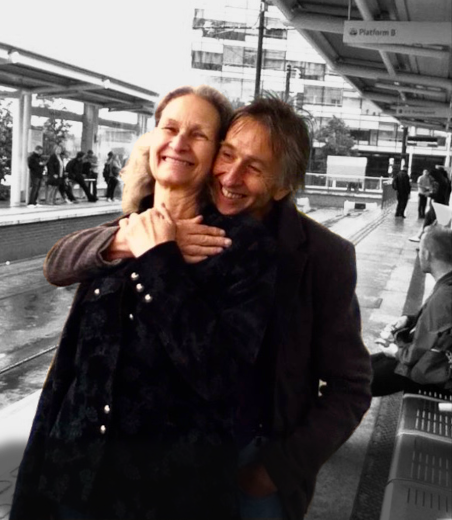
This was us, Lena and Alan Miles, on a rainy day in Manchester back in 2015, two years after Lena was diagnosed with early-onset Alzheimer’s. Still in love, just as we had been for 35 years. Determined to resist the illness, to fight on together. Dementia would not be a death sentence but a life challenge — one last adventure.
The Marathon Years is the story of that thirteen-year adventure with all its ups and downs, its comedy and its ultimate tragedy. The book is a growing collection of short stories which I hope will help, comfort, and inform others facing up to their battle with dementia.
Introducing The Care Combine — tackling the ‘emotional toll’ of dementia
But as well as telling our stories, I’m also setting up a campaign. My experience as a carer demonstrated repeatedly that our current social care system, although well-meaning, could not give either Lena or I the support we really needed.
What were we offered? Visits from care agencies, twice a day for around an hour in total, to assist with personal care — helping Lena in the morning with washing, getting dressed, eating, taking medications, preparing for bed in the evening. I’m not saying that I took to care like a duck to water, but by the time this support was suggested, these were activities I was already coping with perfectly well.
What did we need? What would have reduced ‘the emotional toll’ of dementia for us?
- Training: For all those years as a full-time carer, I had just three hours of training. So how should I best react when Lena insisted her parents were coming to visit? … when they had died over fifteen years ago.
- Better access to information: Where could I get help when Lena could no longer climb the stairs to the bathroom?
- Engagement: We needed a restored sense of meaning and purpose, a sense that we still had a part to play in the community. Without that, life was just sadly slipping away.
- Friendships: To counter the growing isolation that dementia tries to impose.
- Free time: For family carers like me. Not just ‘respite’, a temporary break from care, but full days off every week to allow the carer time to work, to study, to pursue a hobby, to meet friends — or just to recover. If the carer burns out, then the person they care for can no longer stay at home.
Perhaps our Prime Minister’s family had similar needs. This is the fuller context of Andy Burnham’s words, in an interview with the Daily Mail recently, weeks after losing his father to dementia:
“The emotional toll [of dementia] is a burden that is unbearable. The weight is unbearable — it gets too big.
I saw it directly. I saw my mum sinking under the size of that weight.
There was a tendency to focus on the person with dementia and miss some of what was going on around, and particularly the impact of carrying that daily burden on my mum.”
The Care Combine is a framework for a dementia care system that will offer much more than an hour or two of personal care for the person with dementia who lives at home. It’s designed to relieve the pressure on the family carer while improving the quality of life for all concerned. Like the UK’s NHS (our National Health Service), The Care Combine’s services will be available to all, irrespective of their ability to pay. And by redeploying existing care resources more effectively, my aim is to build a system that remains financially sustainable without ever-increasing demands on the taxpayer — even as the numbers affected by dementia rise.
Care Combine content
I’m posting these Care Combine posts here on my website and on Substack, to reach out to a wider audience. The first posts in the series will outline The Care Combine plan, examining how it would benefit people with dementia, their carers, their adult children worrying about their parents’ welfare, and ultimately the state. Then we’ll dive deeper into the practical details. How could we turn the plan into a real live project? Where would we start? How much would it cost? How could it grow? Who would we need in our team? How would we measure success?
Building a community
Today I’m throwing a tiny stone into a huge pond. If you’re reading this, thank you for noticing the little ripple my stone caused. Nothing would make me happier than you tossing another stone right back into the same area as mine.
Around 1 million people are living with dementia in the UK, 7 million in the USA, 57 million in the world according to the latest figures — with around two-thirds of them living in their own homes. The Care Combine plan won’t be suitable for all of them, but the project could potentially be life-changing for millions of people with dementia, their carers and their families, even if only a small percentage of them participate.
But a paper plan counts for nothing. Just last week one of my oldest friends phoned to tell me he’d just been diagnosed with Alzheimer’s. I so much wish I had something to offer him — and especially his partner — more than mere words and ideas and good wishes. But I don’t. And I never will as long as this remains a one-man project.
Today I’d be grateful for your feedback, especially if you’ve had dementia care experience — in your own home or professionally. What one change would have made the greatest difference? Let me know in the Comments box below.
Then as I begin to explain The Care Combine plan, I need you to be my fiercest critics and strongest supporters, testing the validity of my arguments and the practicality of my ideas … and ideally suggesting improvements. As momentum grows, I hope more people will step forward to contribute to Care Combine articles and, ultimately, to participate in the operational teams. And that this small ripple will become a powerful wave.
The schedule
I’ll be publishing at least two new posts each week. One will be an article about The Care Combine. The other will be a new Marathon Years story.
This week’s new Marathon Years story is She Finds Friends Everywhere. If you’ve not come across my stories before, why not try this one, to get a feel for the book?
(This article was originally posted in Substack on November 12, 2026.)

