
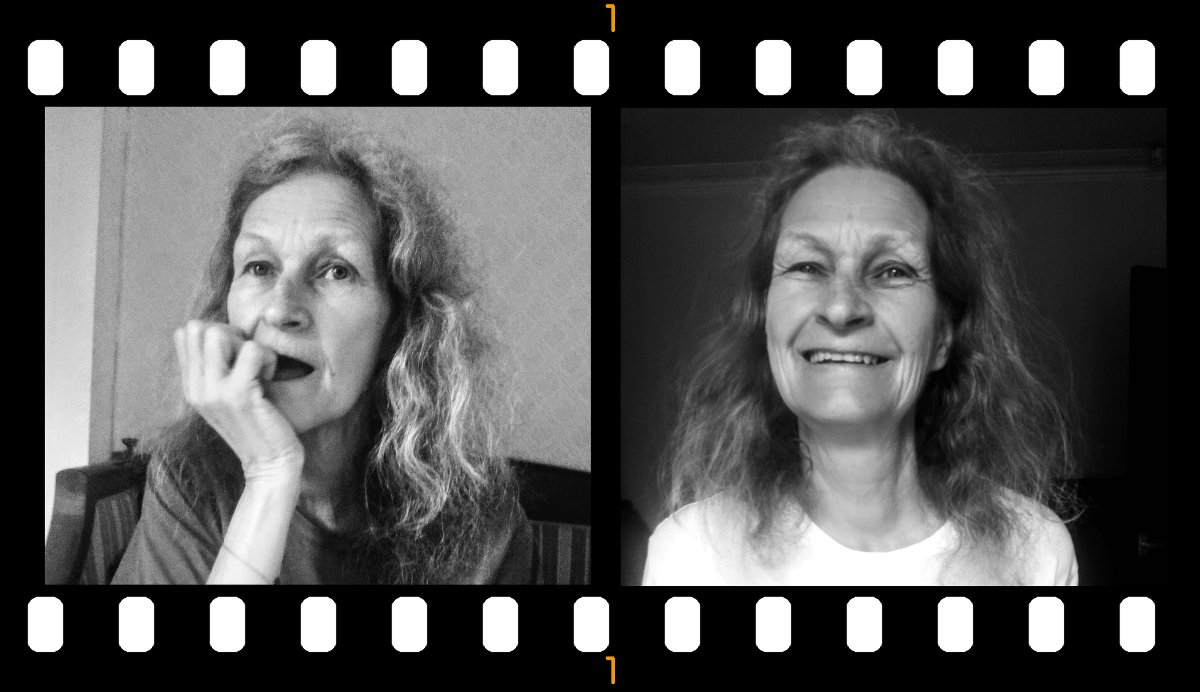
Lena, five years post-diagnosis. Sometimes pensive, sometimes smiling (Photos: Alan Miles)
After Lena’s diagnosis, I was full of ideas about improving life for people with dementia and family carers. But did I practise what I preached?
It’s 6pm and I’ve spent the whole day on the computer. I should stop now and throw something together for dinner. But I must get this newsletter finished. It’s important – explaining the differences between a normal daycare centre and The Bine. And I’m scheduled to publish today. Just a few more minutes…
“Many care homes and daycare facilities are wonderfully kind and comfortable. Nevertheless, most of us think of them as places where you’re gradually signing off from life … a golden sunset. We’d prefer our daily activity centre, The Bine, to be seen as a beautiful sunrise, the anticipation of a new day.”
Odd to be writing about sunset and sunrise on a day like today. It hasn’t stopped raining for the past 24 hours. It’s been grey and cold, one of those nothing days.
Nothing. That’s probably what Lena’s doing. She’s been quiet downstairs for a while. I haven’t seen her since I popped out to the corner shop a couple of hours ago. Perhaps she’s dozing. I’ll leave her for a few more minutes.
“Other Bine characteristics? Well, FUN will always be high on the agenda. PHYSICAL ACTIVITY too. We want to keep our members mobile and participating in our outside activities for as long as possible. Just being able to go for a walk is important.”
I didn’t take Lena to the shop today. Well, it was chucking it down, so she wouldn’t have liked it. And besides, it was just to get milk and bread. I was only going to be away for ten minutes. It would have taken longer than that to find her shoes and coat and get them on.
But I couldn’t just leave her alone any longer. Time to take a break.
* * *
— Hello.
— Hello.
— What you doing?
— Huh?
— What are you doing?
— Oh. Nothing.
Sitting there at the dining-table, with her head resting on her hand, her face was as long as her day had been.
I headed for the kitchen, looking for something I could just whizz into the oven now it was this late.
Oh, she’d been busy. The oven – the fan-oven I never use – was switched on. And where was the umbrella? I’d left it drying in the sink.
— Lena.
— Yes?
— Have you seen the umbrella?
— What?
No, forget it. Umbrella’s not a word she’ll remember.
— Are you coming to help me?
— Yes.
But she didn’t. So I went to turn the TV on, scanned through the channels till I found something with audience laughter. Sometimes that’s enough to get Lena’s attention, even if I’m not sitting there with her.
Waiting for the food, I was back in thinking mode. Why was this newsletter taking so long to write? Was it even a good use of my time? How could I get my Bine message across faster, reach more people?
I smiled ruefully as I remembered a conversation I’d had with a friend last week. There was so much he needed to change in his small business, he said, but he never had time. Stop and take stock, I’d advised, or it’ll just get worse and worse.
It’s easier handing out good advice than taking it yourself. I knew I needed to stop and think too. But after I’d finished the newsletter. Maybe.
The food was ready. I’d paid so little attention that I can’t remember what it was now. Something Chinese though, with rice, and easy to eat with a spoon, so I risked serving it in front of the TV. Lena often struggles with food on her lap these days. Anything runny invariably ends up all over her or on the floor. But this, whatever it was, seemed safe. She managed to cope well, and cleared the plate.
Now perhaps, I could get her to settle down with me for a while, watching the TV on the sofa. After all those hours writing, I really owed her some of my time and attention.
But no, after a few minutes she was up and pacing, finally coming to a halt just in my peripheral vision as I watched the screen. Without looking, I knew she was staring at me. And I knew why.
— Are you tired?
She nodded.
— Shall we get ready for bed?
— Yes, om du vill.
The Swedish for “If you want”.
So we went upstairs. There in the bed was the umbrella. A new variation on wetting the bed.
* * *
Fifteen minutes later, I was back at work on my Bine description.
“Some may decide they don’t want to participate right now. If that’s their choice, that’s their right. Perhaps they just want to rest for a while. Telling your brain to keep up all the time can be tiring with dementia.”
But the reason Lena was in bed wasn’t because her brain had been working overtime. She was tired because she’d had no stimulation all day long. She was bored.
That’s why we desperately need a place like The Bine, an everyday, all-day community space for people like Lena. With dementia, it’s not enough simply to take care of the basic functional needs – keeping people safe, warm, fed, clean, medicated. That might be enough for a pet. But we’re dealing with people. And people need to belong, to share, to have purpose and variety and choice, to feel free. None of that changes with dementia. The only difference is that now, just the same as with the functional needs, people need a bit more outside help. Or in Lena’s case, with Alzheimer’s well advanced, a lot more help.
Technically, the brain is not a muscle. But just like a muscle, it needs exercise. Stop using it altogether and it withers and dies.
There’s an uncomfortable paradox in my life. Here I am, campaigning for The Bine, purporting to know all the answers, talking about getting people reconnected and engaged. But every moment I spend at the computer, I’m leaving Lena alone and unengaged. I’m a fraud.
How much time have I actually spent with her today? Maybe a couple of hours. How have I stimulated her? Hardly at all. All I’ve done is the functional stuff. And I wonder. Am I capable of giving Lena what she needs? Would she be better off in full-time care? Not because she wants it, but because I’m failing her. At least there’d be other people around.
* * *
It’s 2am, and my newsletter is finally finished. I close everything down, then go into the bedroom, deliberately making just enough noise to wake Lena. It’s become a habit recently, after we had a series of bedtime accidents. I write till the early morning hours, then before turning in myself, I rouse Lena, and lead her to the bathroom. So far, it’s working well.
The bedside light is on – I always leave it on – and I can see she’s awake, though her eyes are still closed. I gently call her name:
— Lena. It’s that time. Shall we go to your nice bathroom?
A smile plays on her lips. She knows it’s me, and she’s happy I’m there. She stretches, but the bed is warm and comfortable. She’d like to stay there. But when I take her hand, there’s only token resistance. She knows what she has to do, and slowly allows herself to be eased out and up. As her feet touch the floor, she sings her little going-to-the-bathroom-in-the-middle-of-the-night song:
— Dum ti dum ti diddly doo.
I take her other hand and we slowly work our way along the corridor, me the train, she the carriage, puffing and hooting as we reach the bathroom door. I shunt her in, help her with the clothes, sit her down.
She’s still only half-awake, but she’s studying my face as I stand by the door, waiting. There’s trust in her eyes. Then she suddenly breaks into a broad grin. So do I. She snorts, and she’s giggling, can’t stop. Isn’t it silly, this situation we somehow find ourselves in? I’m giggling too.
How could I ever have thought that Lena might be better in someone else’s care? How could anyone else know the secret codes, the little looks and touches and gestures and words and timings built up between us over years? Without them, a dementia life would be intolerable. With them, there are still little moments of delight.
I’m on the right track with The Bine, I’m sure. A care solution that would preserve and protect our home relationship, while giving Lena the social stimulation that I’m struggling to provide.
I’m struggling, but I’ll try to do better tomorrow.
