People with dementia still want to stay involved. Let’s put meaning and purpose back into their lives.
In the Care Combine plan, people with dementia would come together to spend their daytime hours at The Bine, participating in community-focused projects designed to give them a renewed sense of meaning and purpose. They’re accompanied by family carers who volunteer for two days a week, but get their daytime hours free for the rest of the week.
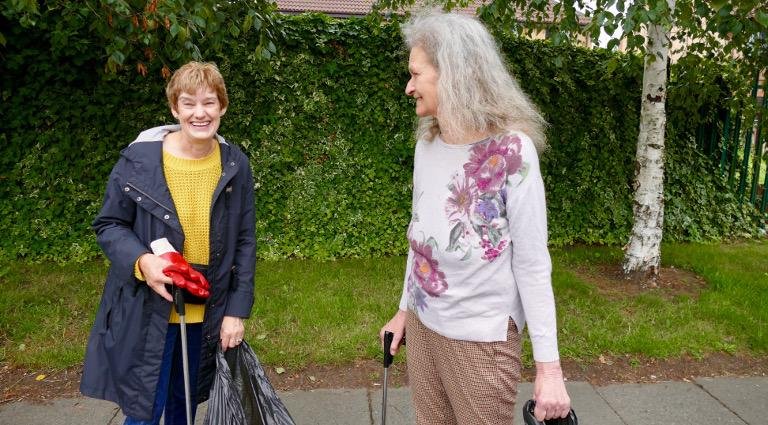
This is an example of a typical dementia activity at The Bine. Lena was diagnosed with early-onset Alzheimer’s five years ago. Her particular variant has stripped away her language skills: she speaks in word jumbles and doesn’t really understand speech. She lives at home with me (Alan), her husband.
October 2018
As we walk the mile to the meeting-point, I’m explaining to Lena what we’re going to do this morning. I don’t think she understands a word I’m saying, but she’s happy. For once, we’re getting moving straight after breakfast. Alan’s not sitting at the computer. She’s free.
It’s just a small volunteer group today. Joe and three others. I’m delighted to see Gina, our local councillor. She was one of the team I met at the Salford City Council last week to introduce the Care Combine project, my plan to re-imagine dementia care.
I do the introductions, and Lena steps forward confidently to shake hands and say hello — but in the gobbledygook only she understands. I’m her interpreter.
— How’s your Swedish, Gina? Lena gets a bit muddled with her languages these days. Don’t you, Lena?
Lena grins. It wasn’t Swedish — well, not intelligible Swedish anyway. But it doesn’t matter. Everybody understands what’s going on. And they’re not embarrassed. Good.
It’s time for equipment distribution with some shiny red protective gloves. Lena takes one and admires it, but I’m sure we’ll never persuade her to put it on. I try to help, but she won’t unclench her fingers, and pulls it straight off. It’s uncomfortable. Not to worry. I doubt she’ll be picking up much anyway.
But actually, as we get started, Lena’s a pretty good helper. I need one hand for the litter grabber, so it helps to have an assistant to hold the sack open for the things I pick up. I show her how.
— Look, one hand here, and the other here … Not there, here, so the sack stays open. Hold it just here — no, not the grabber, the sack! Look, like this. That’s it. You’ve got it. Great! That really helps me.
I must have repeated the instructions a dozen times as she struggled with the placement of her hands, then forgot to remember to grip. Nevertheless, we made good progress for about 45 minutes, filling a whole sack. And Lena was willing. She wanted to do it right.
But then her concentration began to waver. We’d caught up with Gina and as we filled our sacks, the two of us started chatting about our meeting at the Council, then about other local issues, getting to know one another better. We talked about the history of the Salford Shopping Centre, about the importance of the town centre as a meeting place, about shops we were sorry to see closed down. Lena started wandering away. She didn’t feel part of this conversation so why should she hang around? I wasn’t too concerned. We were in a pedestrian lane with no danger from traffic, so as long as I kept an eye on her …
A girl was coming towards us, pushing a pram, the hood edged with white fur. Now this was more interesting. Lena made a beeline for them. I watched. I saw the girl stop, smile … and then the look of total confusion on her face.
— You what?
Help was at hand. I strode across and explained — cheerfully.
— Sorry. Lena has Alzheimer’s and she gets a bit muddled with her languages.
I wouldn’t have been that explicit three years ago, but now I know that Lena doesn’t understand words — not at that speed and not unless I’m talking directly to her. She relies on facial expressions and tone of voice. Hence, cheerfully.
And besides, it’s part of my mission to bring dementia out into the open — to put aside the secrecy and embarrassment, to normalise it.
I peeked inside the pram. Unlike Lena, I don’t have a soft spot for babies, but this one was undeniably cute — tiny, with a big red ribbon tied in a bow across her forehead. A proud mother clearly.
— Look Lena, a brand new baby!
I asked the mum.
— How old is she?
— Two weeks.
— So is this your first time out together?
— Yes. Well, no, I took her home from the hospital ….
And the girl was telling us her story, relaxed now as we street-cleaners gathered round to admire.
Then it was back to work for another hour. Lena never quite got back to it, frequently wandering off, turning and obediently coming back when I called her. I continued chatting to Gina, then to Eric. It turned out he lives just around the corner from us and has been campaigning for ages to get the mucky streets and alleyways in our neighbourhood cleaned up. I’m ashamed to say I ignored his circular posted through the door a couple of years back, but now we’ve met …
* * *
So let’s consider what everyone got out of this community-focused morning, starting with Lena. Did she enjoy being a dementia volunteer? Was she able to help?
It’s true that Lena was able to contribute far less than she did three years ago. A few months from now she might not be able to help at all. And she was probably completely unaware that her efforts made a difference to the community.
It’s true too that she needed my full-time attention. If this were one of the Bine dementia activities, we’d need to be sure that we had one helper for every person like Lena, whose condition is fairly advanced. And like today, we’d need to keep well away from traffic.
But let’s look at the positives.
Did Lena enjoy the morning? There’s no point asking her. She can’t vocalise her feelings, any more than she can remember them. But there are other ways carers learn to measure wellbeing. How often did she smile? Were there signs of frustration or boredom? Did she seem engaged with what was going on around her? Did she seem stimulated? By every measurement, I’d say that our three hours away from the house were a big success.
But that’s not all. A few more people — Gina and the young mother — came into close contact with dementia, learning about it not from a course or by talking about the problem, but seeing it face to face. I hope they’ll have learnt that even people with advanced dementia don’t need to be shut away, can still function within normal everyday society, even if they need lots of help.
And finally, there were big positives for me, the dementia carer. Volunteering gave me a feel-good factor, and brought me out of the dementia cocoon, helping me to spread my wings and fly again. Days like this take the stress out of care.
This is just one example of typical Care Combine dementia activities. Here are a few other group activities, all designed to serve the community and give people with dementia and their volunteer carers a sense of achievement.
- Putting on a musical performance as a choir.
- Recording stories of their lives when they were young for their children and grandchildren. Perhaps their stories could have a central theme, such as playground games or lost streets in the local area.
- Helping housebound neighbours with the shopping or walking the dog.
- Growing vegetables and donating them to a food bank.
- Having story-telling sessions for toddlers and their parents, who are invited to drop in to The Bine for a coffee after the morning school run.
These are just ideas to get us started. Eventually the Care Combine team will need to create a manual with dozens of different Bine dementia activities, together with guidance notes on how to set them up. Perhaps you’ve been involved with community volunteer groups where people like Lena supported by carers like me would be able to participate. But whatever your idea for an activity that would restore meaning and purpose to dementia-affected lives, I’d love to hear it. Just add your idea, however brief, to the comment box below.